Oodles Logo
Get a Free Quote
AI iconShare Your Requirements
Insights
Oodles Platform
Author Img
Geetansh is a talented Content Writer with extensive expertise in the field. He has specialized skills across various domains, including press releases, news site content, SEO, and website content creation. With a strong background in content marketing, Geetansh is well-suited as a content strategist. In this capacity, he develops engaging social media posts and meticulously researched blog entries, all of which contribute to a distinctive brand identity. By collaborating effectively with his team, he utilizes his cooperative skills to foster overall client growth and development.

Geetansh Bassi (Author)

Associate Consultant L2 - Content Development

Technical Contributors
Author Img

Pawanpreet Singh

Solutions Architect

Pawanpreet is an seasoned Project Manager with a wealth of knowledge in software development, specializing in frontend and mobile applications. He possesses a strong command of project management tools, including Jira, Trello, and others. With a proven track record, he has successfully overseen the delivery of multiple software development projects, managing budgets and large teams. Notable projects he has contributed to include TimeForge, Yogyata, Kairos, Veto, Inspirien App, and more. Pawanpreet excels in developing and maintaining project plans, schedules, and budgets, ensuring timely delivery while staying within allocated resources. He collaborates closely with clients to define project scope and requirements, establish timelines and milestones, and effectively manage expectations. Regular project status meetings are conducted by him, providing clients and stakeholders with consistent updates on project progress, risks, and issues. Additionally, he coaches and mentors project leads, offering guidance on project management best practices and supporting their professional development.

IP Protection in the Age of AI-Generated Code and Content

Author Img
Geetansh Bassi
Nov 04, 2025
Blog Img
Area Of Expertise:
IP Protection

Artificial intelligence has changed the way businesses create and manage digital assets. From writing code to generating marketing visuals, AI tools are helping teams move faster and work smarter. But as these systems start creating content and software, a serious question arises: Who owns what?

That's where IP Protection becomes essential. In the age of AI-generated code and content, traditional ideas about intellectual property no longer fit neatly. Companies now need to rethink how they secure ownership, manage risks, and protect value in their creations.


Understanding IP Risks in AI-Generated Work

AI systems can create lines of code, images, designs, and written text that look entirely original. However, these outputs are often derived from existing data. If the AI tool was trained on copyrighted material, parts of that work could unknowingly appear in the final product.
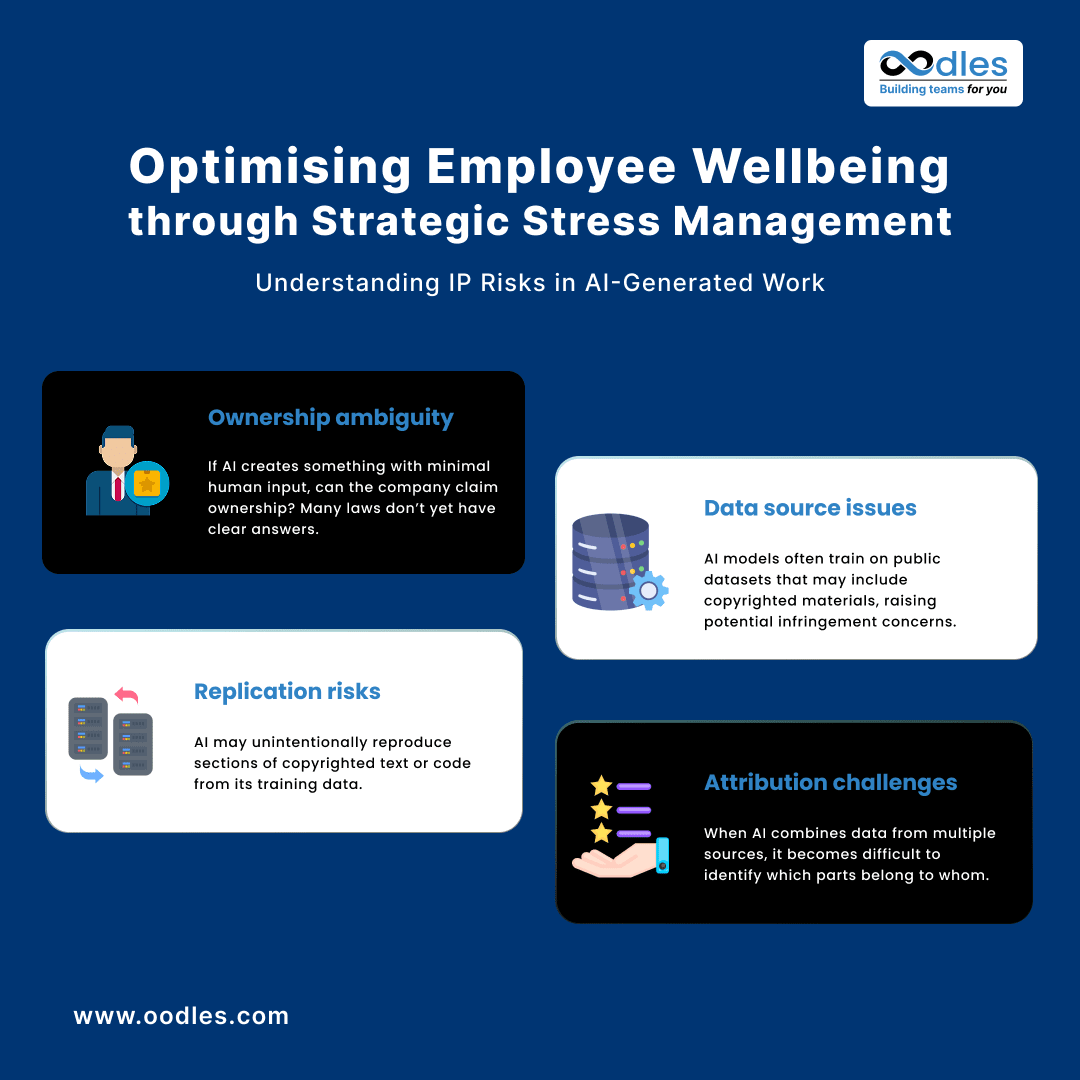
This creates several risks:

  • Ownership ambiguity: If AI creates something with minimal human input, can the company claim ownership? Many laws don't yet have clear answers, which makes it crucial to define how much human involvement is required for a creation to be legally protected.

     
  • Data source issues: AI models often train on public datasets that may include copyrighted materials, raising potential infringement concerns. Without transparency about data sources, businesses may unknowingly use content that violates another party's rights.

     
  • Replication risks: AI may unintentionally reproduce sections of copyrighted text, code, or images from its training data. Even small similarities can lead to legal disputes if the original owner identifies the overlap.

     
  • Attribution challenges: When AI combines data from multiple sources, it becomes difficult to identify which parts belong to whom. This lack of traceability makes assigning credit and ownership complicated.

     
  • Inconsistent global regulations: Different countries have different interpretations of AI-created IP, which makes international protection more complex. What qualifies as owned work in one country may not be recognized in another.


Understanding these risks helps businesses recognize why IP Protection isn't just a legal checkbox but a safeguard for long-term innovation.


Key Challenges for Businesses

Companies using AI tools face a new mix of legal and technical challenges.

  • Unclear legal frameworks: Laws around AI-generated intellectual property are still developing, leading to uncertainty about how courts will interpret ownership.

     
  • Compliance and licensing: Some AI platforms have unclear terms about who owns the outputs or how they can be used commercially.

     
  • Protecting proprietary code: When developers use AI coding assistants, parts of company-specific or confidential code could inadvertently be shared or reused in ways that compromise IP rights.


Without a structured approach to IP Protection, even a small oversight could expose a business to legal disputes or data leaks.


Practical Steps to Strengthen IP Protection

Let's look at how businesses can act rather than just react. Here are practical steps to establish stronger IP Protection in an AI-driven environment:

  1. Define clear ownership policies with IP Protection

    Establish internal policies that define who owns the output when AI tools are used. Make sure employees understand these rules and sign relevant agreements when working with AI-generated content or code.
     

  2. Use secure development environments

    Keep AI-assisted development within secure repositories and limit external tool integrations that could compromise source code or proprietary data.
     

  3. Track data and code provenance

    Document where training data comes from and how code or content is produced. This transparency can help prove originality if IP ownership is ever challenged.
     

  4. Conduct regular IP audits

    Periodic audits help identify any code, content, or data that might overlap with third-party rights. Audits also help you maintain compliance with licensing terms.
     

  5. Implement digital rights management (DRM)

    DRM systems help control how digital assets are used and shared. This ensures your AI-generated work is protected from unauthorized access or duplication.
     

By taking these steps, companies can build a solid foundation for IP Protection that's proactive instead of reactive.


Building Ethical AI Practices for Better IP Compliance

Strong IP management starts with responsible AI use. Ethical development practices ensure that the data used in training, testing, and deployment respects existing copyrights and privacy laws.

  • Transparency in data sourcing: Always verify that training datasets are either open source, licensed, or created in-house.
     
  • Consent and attribution: When using third-party data, ensure proper permissions are obtained and credit is given where required.
     
  • Documentation: Keep detailed records of AI training processes, model behavior, and decision logs. This makes IP ownership easier to validate later.
     

    Responsible AI practices not only strengthen IP Protection but also build trust with users, clients, and regulators.


Legal and Technological Tools Supporting IP Protection

Legal and tech-based solutions can work hand-in-hand to safeguard AI-generated assets.

  • Register your intellectual property: Even if AI is involved in the creation process, you can still register the human contributions that shape the final output.
     
  • Use licensing agreements for AI tools: Before deploying an AI platform, check its licensing terms carefully to ensure your organization retains rights over outputs.
     
  • Adopt detection tools: Use software that scans for code or content similarities to existing materials, helping prevent unintentional copyright violations.
     

These combined measures create multiple layers of IP Protection, reducing the chance of disputes or misuse.


Preparing for the Future: How Businesses Can Stay Ahead

The connection between AI and intellectual property will continue to evolve. Businesses that stay informed and proactive will be better positioned to protect their assets.

Here's how to stay ahead:

  • Develop internal guidelines: Clearly define how AI can be used in development, marketing, or design work.
     
  • Collaborate with experts: Work closely with both legal advisors and technology specialists to ensure your approach meets regulatory standards.
     
  • Stay updated: Monitor upcoming AI and IP regulations. Governments and global organizations are introducing new rules regularly.
     
  • Invest in compliance and governance: Establish a dedicated team or framework to handle audits, ownership tracking, and contract management.
     

In short, the best form of IP Protection is a combination of awareness, responsibility, and preparation.


Conclusion

AI is unlocking creativity and productivity across industries, but it's also changing how we think about ownership and originality. Businesses that treat IP Protection as a strategic priority, not an afterthought, can innovate confidently while avoiding legal and ethical risks.

With clear policies, responsible AI practices, and the right tools in place, companies can turn AI's potential into secure, sustainable value.


FAQs (Frequently Asked Questions)


1. Why is IP Protection important for AI-generated content and code?

Because AI tools often rely on external data, IP Protection ensures your outputs are legally owned and shielded from infringement claims.

2. How can businesses prove ownership of AI-generated work?

Maintaining detailed records of human involvement, training data, and creation processes helps establish ownership and originality.

3. Are AI-generated assets eligible for copyright registration?

It depends on the jurisdiction. Some countries allow copyright registration for human-assisted AI creations, but laws are still evolving.

4. What steps can companies take to improve IP Protection in AI development?

Create ownership policies, perform regular IP audits, verify data sources, and use secure repositories to protect your AI-generated assets.