


Imagine a master architect collaborating with an oracle—one brings timeless blueprints, the other foresees storms before clouds gather. This is the new frontier of project management, where the Work Breakdown Structure (WBS) meets the predictive power of Artificial Intelligence (AI).
In today's fast-paced environment, projects demand both meticulous structure and agile adaptability. The WBS serves as the architectural framework, defining every task, milestone, and dependency, while AI transforms it into a living, learning system that anticipates risks, detects scope creep, and recalibrates plans in real time.
Together, AI-driven project planning and predictive analytics empower leaders to achieve real-time project visibility and sustainable innovation.
A Work Breakdown Structure is a hierarchical decomposition of a project into manageable components or work packages. It serves as a visual, structured roadmap, breaking the total project scope into clear, actionable tasks. This fosters clarity, comprehensive coverage, ensures task dependency management, and strengthens accountability through intelligent task management.
Key WBS benefits:
This framework is foundational for managing projects within the Iron Triangle constraints: scope, time, and cost, which dictate project success. It also supports resource optimization models for long-term project efficiency.
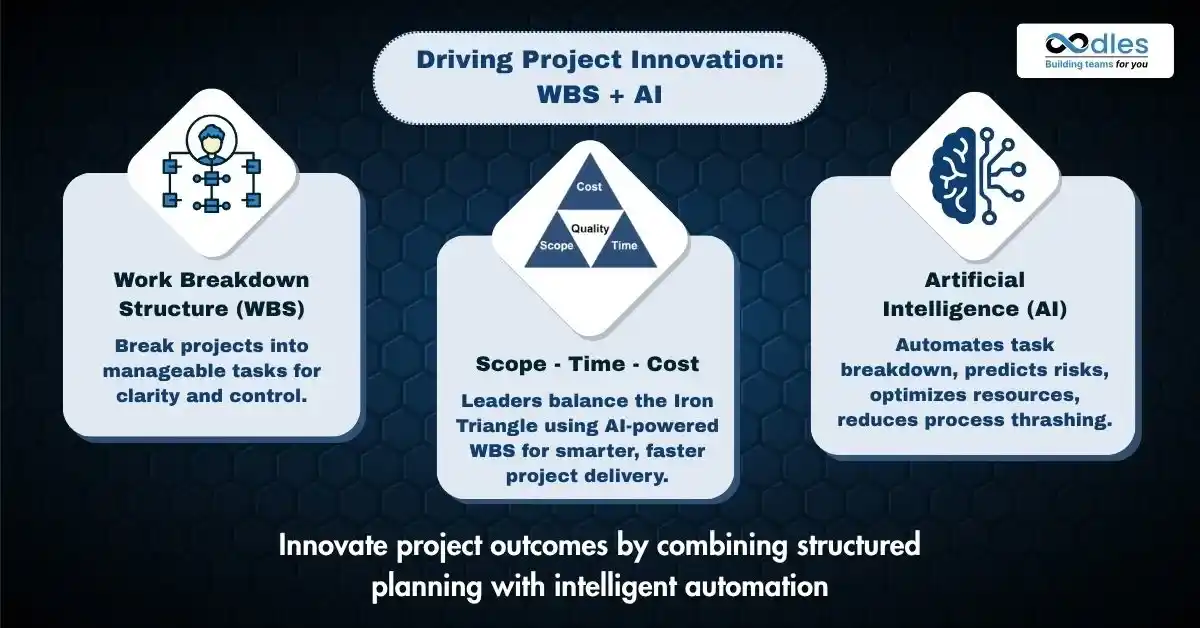
The Iron Triangle, or Triple Constraint, emphasizes the interdependent relationship between:
Changing any one factor impacts others, requiring leaders to maintain balance. The WBS offers a comprehensive view to plan within these constraints while proactively minimizing risks. In modern workflows, AI-powered dashboards complement this balance by offering data-driven decision-making and transparent progress tracking.
While WBS provides structure, AI adds automation, intelligence, and adaptability, creating a dynamic project planning environment supported by predictive project analytics.
Traditional WBS planning involves repetitive, inefficient revisions—known as process thrashing. AI drastically reduces this by applying pattern recognition and analyzing historical project data to propose optimized task breakdowns early, shortening planning cycles and minimizing rework. This makes project teams more agile and responsive.
Using Natural Language Processing (NLP) and Machine Learning (ML), AI tools automatically detect missing or conflicting tasks in the WBS. Suggestions include:
This enhances consistency and early risk management with less manual effort, improving dynamic scheduling and real-time workflow adaptability.
AI continuously analyzes project data to forecast risks such as delays, budget overruns, or resource shortages. It recommends real-time resource forecasting and reallocation, matching tasks with team skills and availability to uphold Iron Triangle constraints. This enables agile project adaptation amid uncertainties and supports AI-based resource optimization.
AI-driven dashboards provide transparent, real-time project visibility into health metrics and WBS progress. They empower stakeholders with data-driven collaboration, accelerate decisions, and enable prompt corrective actions through intelligent project analytics.
By leveraging feedback loops and historical project outcomes, AI refines WBS templates and predictions, driving ongoing innovation in project delivery optimization. Over time, this creates continuous learning ecosystems for adaptive planning and execution.
AI accelerates WBS creation by analyzing project charters and documents to generate detailed, hierarchical task lists. This reduces process thrashing, allowing teams to spend more time executing and less on revisions through automated WBS generation.
AI intelligently matches team skills to task requirements, optimizing resource allocation, reducing waste, and boosting productivity. This helps leaders adhere to budgets and schedules effectively through cost-efficient project management.
AI's predictive analytics enable leaders to anticipate and mitigate risks before impacting project scope, time, or budget, preserving the balance of the Iron Triangle. This leads to risk-resilient project execution.
Real-time updates via AI-powered dashboards improve transparency and stakeholder collaboration. Faster issue resolution and workflow innovation strengthen teamwork and ensure real-time decision visibility.
AI learns from project history, helping leaders iteratively refine WBS structures and processes, steadily enhancing efficiency and innovation through AI-driven process optimization.
Learn more in our guide on why every project needs a Work Breakdown Structure.
Emerging innovations include:
Adopting these advancements will be crucial for leaders aiming to drive agility, innovation, and AI-powered project success in complex environments.
Integrating Work Breakdown Structure with AI-powered automation and intelligence delivers:
Leaders using AI-enabled WBS position their organizations to deliver projects faster, smarter, and more innovatively—securing a competitive advantage in today's evolving digital project landscape. Talk to Oodles experts to drive your next project success.
What is a Work Breakdown Structure (WBS) in project management?
A WBS is a hierarchical framework that breaks a project into smaller, manageable tasks or deliverables, helping teams organize work clearly and track progress effectively.
How does the Iron Triangle affect project management?
The Iron Triangle represents the balance between project scope, time, and cost. Changes in one factor affect the others, and successful management involves maintaining this balance using AI-powered dashboards.
What is process thrashing in WBS planning?
Process thrashing refers to repetitive, inefficient revisions and rework during the WBS creation phase, causing delays. AI-driven project analytics help reduce this by proposing optimized WBS structures early.
How does AI improve the Work Breakdown Structure?
AI automates WBS generation, detects missing or conflicting tasks, predicts risks, and suggests intelligent resource allocation, making project planning faster, more accurate, and adaptive.
Can AI help with risk management in projects?
Yes. AI uses predictive project analytics to identify potential risks related to schedule delays, budget overruns, or resource shortages, allowing proactive mitigation strategies.
What are the benefits of integrating AI dashboards in project management?
AI dashboards provide real-time insights into project progress and health, improve transparency, enable better stakeholder collaboration, and support data-driven decision-making.


© Copyright 2009-2026 Oodles Technologies. All Rights Reserved.