


Projects slow down when you cannot see what is happening in your team. A task gets assigned to someone who is on leave. One member drowns in work while another sits idle. Deadlines slip, and no one notices until it is too late. It's exactly like driving blind without Google Maps - you don't see the jam until it's too late. That is why an effective resource tracking acts as the backbone of effective workload management and smart task planning. It ensures the right people handle the right work at the right time.
Without visibility into who is doing what, resources get wasted, employees burn out, and profits quietly leak away. The entails the hidden danger of poor workload practices, the silent profit killer. Even McKinsey & Company stats showcase that - Companies lose an estimated $1.1 billion over five years due to disengaged employees and low productivity.
In this blog, we'll explore what workload management truly means, the hidden costs of poor practices, real-world examples of missed profits, and smart strategies to fix the problem.
Definition: “Workload management is the art of balancing tasks, people, and time so projects move forward smoothly. It involves scheduling and prioritizing tasks to balance workloads, avoid over- or underutilization, and maintain employee satisfaction.”
The primary objective of workload management is to assign an optimal amount of work to each team member. Assigning too much can lead to burnout and errors, while assigning too little can result in underutilization and lost productivity. Therefore, tracking the resources are important. The goal is to find the right balance that maximizes efficiency without overwhelming anyone. Achieving this involves understanding team members' capacities, skills, and availability, and adjusting assignments accordingly to maintain engagement and performance. This balanced approach helps protect margins, enhance work quality, and reduce turnover, ultimately benefiting both employees and the organization.
Think of it like running a restaurant kitchen:
Key elements of workload balance include:
Resource tracking monitors how people, tools, money, and time are being used across a project. It gives project managers visibility into availability and utilization, ensuring resources are neither idle nor wasted. For instance, a manager can quickly check if a designer is free to take on new work or confirm whether the budget allocated for cloud servers is being consumed effectively. In short, it answers the key question: “What do we have, and where is it being used?”
Workload management actively balances and distributes tasks among team members to maintain efficiency and prevent burnout. By assigning tasks fairly, managers ensure no one is overworked while others sit idle. For example, splitting five development tasks evenly between two developers keeps productivity steady and morale intact. It focuses on answering the critical question: “Is the work divided properly so the team stays productive without burnout?”
Explore this blog | What is Resource Tracking in Project Management?
Poor workload management does not just frustrate teams. It quietly erodes profitability. From unclear priorities to employee burnout, the ripple effects spread across productivity, quality, and customer satisfaction.
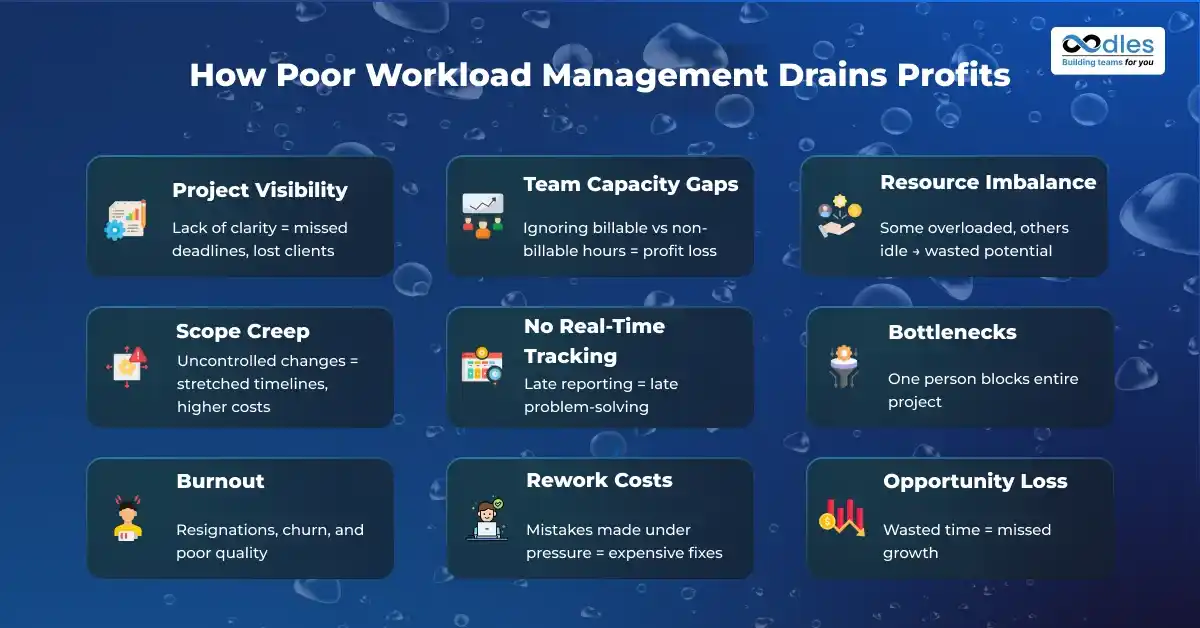
Here is how:
When managers do not have clear visibility into workloads, tasks often get duplicated, priorities clash, and accountability slips. Teams spend more time figuring out what needs to be done instead of delivering results. This lack of clarity delays decisions, creates confusion, and slows down project momentum.
Example: A marketing agency overloaded one designer with 12 creatives in a week while another had only two. With no visibility into task distribution, the overworked designer made mistakes, revisions piled up, and deadlines slipped. The client walked away, costing the agency not just the project but also future referrals. This example shows how poor visibility directly translates into lost revenue and damaged reputation.
If businesses do not measure how much time is billable versus non-billable, they overestimate resource capacity and productivity. Teams may appear busy, but if most hours go into admin work, firefighting, or unplanned tasks, profitability collapses.
Example: A consulting firm that ignored non-billable hours spent weeks on unpaid client support. The firm wiped out the margin on otherwise profitable projects.
Want a visual overview? Watch our Resource Tracking video to see how it works in practice.
Resource management and resource allocation involves both short-term and long-term balance. In fact, studies tell, companies with poor labor productivity management can lose up to 20% of their potential profitability due to inefficiencies and misallocation of resources. If managers fail to align daily execution with strategy, some employees become overloaded while others remain underutilized. This imbalance causes burnout, missed deadlines, and wasted potential.
Example: In a software agency, senior developers became swamped with minor bug fixes while junior developers sat idle. The imbalance slowed delivery and inflated project costs.
Scope creep quietly drains profits. According to a PMI report, nearly 50% of projects experience scope creep. If teams cannot adapt to new requirements or shifting client demands, timelines and budgets spin out of control.
Example: A product team accepted last-minute feature requests without limits. A three-month release stretched to six months, doubling costs while competitors launched faster.
Relying on outdated reports or gut feelings creates blind spots. Without KPIs and real-time tracking, managers miss early signs of delays and overruns.
Example: A construction firm relied on weekly summaries instead of live tracking. They spotted cost overruns too late. Materials had already been purchased and timelines locked. Real-time KPIs could have flagged the problem weeks earlier.
Workload mismanagement often creates bottlenecks where one overburdened employee holds back the entire project.
Example: In software development, a single developer got buried under critical tasks while others stayed idle. Deadlines extended, costs rose, and the project stalled.
Burnout does not just reduce performance. It drains company profits in multiple ways:
Case Study: An E-commerce SDLC Project
It was a familiar story. A project that started with so much promise was now struggling. The e-commerce team was talented and dedicated, but their work had slipped into quiet chaos. Deadlines were missed, people were frustrated, and progress seemed unpredictable.
The underlying issue wasn't skill or effort. It was the absence of effective workload management. Without visibility into task ownership, dependencies, and workloads, the project kept hitting roadblocks.
Here's how things unfolded across the development lifecycle:
Lack of Visibility during the Development Phase
Alex, a junior developer, was tasked with integrating a new feature with the user authentication system. Meanwhile, Sarah, the lead developer, was the only one who fully understood the legacy payment API. At the same time, a critical bug flagged by QA had been assigned to another developer who was already on a planned vacation.
Because the project management tool wasn't tracking availability or dependencies clearly, the bug sat untouched for a week. Other developers, who had bandwidth, stayed idle because they couldn't see where the gaps were. Tasks slipped simply because no one had full visibility into who was doing what.
Uneven Workload during the Testing Phase
When the “Wishlist” feature finally moved into testing, QA lead Mark was greeted with a mountain of bug reports, most tied back to the authentication integration.
The issue wasn't just the bugs themselves. It was the fact that Alex, a junior developer, had been overloaded with a task far more complex than his experience allowed. A senior developer could have handled it in half the time, but because no one was monitoring workloads, the imbalance went unnoticed. The result was poor code quality and a bottleneck in testing.
Slipping Deadlines during the Deployment Phase
As deployment approached, the product manager announced the go-live. But just days before, the team realized something critical: the third-party API for product recommendations hadn't been integrated.
That task, which depended on Sarah completing her other work, was never flagged as a dependency. With no roadmap visibility and no one tracking the critical path, the project lost another week. What should have been a smooth launch was now a scramble.
The takeaway is clear: Without effective workload management, even the most skilled teams can stumble. Visibility, balanced task allocation, and dependency tracking are not just “nice to haves.” They are the foundation of predictable delivery.
Explore Related Insights | Why Asset Tracking Tools Matter in Project Management
The hidden costs of poor workload management disrupt businesses more than they realize. They spread like a ripple effect:
You can fix these issues with smarter planning. Successful companies use strategies such as:
Managing work manually is like driving without a map. The right technology gives GPS-level clarity.
Modern solutions provide:
Poor workload management is not merely an inconvenience; it is a direct attack on your profitability. Every hour wasted on fixing mistakes, every employee lost to burnout, and every deadline missed chips away at your company's financial health.
The solution is a proactive approach powered by smart technology and a clear understanding of your team's capacity. By mastering workload management, you not only eliminate inefficiencies and protect your profits but also create a more engaged and productive team, ready to seize new opportunities.
At Oodles, we help organizations build tailored workload and resource management solutions that streamline operations, prevent burnout, and protect profitability. If you're ready to stop the profit leaks and optimize your operations, contact a specialist in custom workload management solutions. The right tools can transform your business from reactive to strategic, ensuring a healthier bottom line and a stronger future.
Contact us today to learn how you can save profits with effective workload management.
Q1: What is workload management in simple terms?
It is the process of balancing tasks across people and time so work gets done efficiently without overloading anyone.
Q2: Why is workload management important for businesses?
It prevents burnout, reduces idle time, improves productivity, and keeps projects profitable.
Q3: How does poor task planning reduce profits?
It causes delays, mistakes, employee churn, and wasted resources. All of these increase costs.
Q4: What is the best way to manage tasks and resources?
Custom-built solutions with resource tracking, utilization reporting, and forecasting are the most effective.
Q5: How can businesses prevent employee burnout?
They can track workloads in real time, redistribute tasks fairly, and forecast capacity for peak demand.


© Copyright 2009-2026 Oodles Technologies. All Rights Reserved.